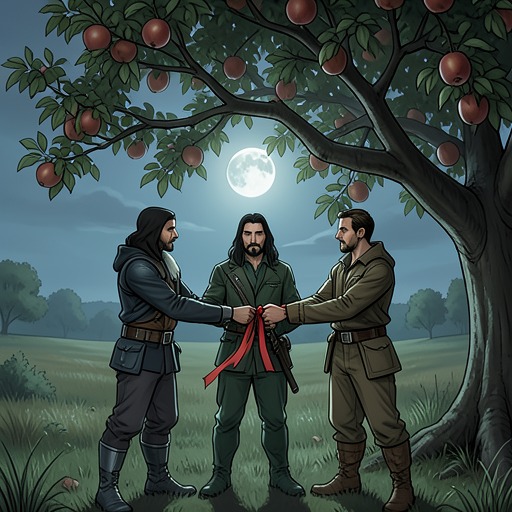
Guan Yu’s Three Conditions of Surrender
The Romance of the Three KingdomsGuan Yu’s Three Conditions of Surrender are the terms Guan Yu sets when Zhang Liao persuades him not to die resisting Cao Cao at Xiapi. They preserve his duties to the Han and to Xuande while allowing him to protect Xuande’s wives in the immediate crisis. The agreement permits Guan Yu to enter Cao Cao’s service, but it does not settle his loyalty: once he learns Xuande is alive, he invokes the promise that he may leave and return to him.
The dilemma at Xiapi
After Xuande’s defeat, Guan Yu faces a choice between death and surrender. Zhang Liao argues that dying would betray three obligations: Guan Yu had sworn with Xuande and Zhang Fei to die alongside his brothers; Xuande had entrusted his wives to Guan Yu’s care; and, as a defender of the Han, Guan Yu should not abandon the dynasty’s cause merely to die in battle. Zhang Liao’s proposed alternative is submission, which would leave Guan Yu alive, allow him to protect the women, and preserve the possibility of remaining faithful to the Peach Orchard oath.
Guan Yu asks what he is expected to do, then answers Zhang Liao’s three arguments with three conditions of his own. The exchange makes the agreement a negotiation over the meaning of loyalty, not merely a decision about who commands him. Surrender can be accepted only if it does not erase the ties and duties that preceded it.
The three conditions
First, Guan Yu says he will surrender to the emperor, not to Cao Cao. The distinction keeps his public allegiance directed toward the Han even while he enters the service of the powerful minister who controls the court. It gives the arrangement a political form that Guan Yu can accept without describing himself as Cao Cao’s unconditional subject.
Second, Guan Yu demands complete authority over the protection of Xuande’s wives. This condition answers the immediate responsibility that Zhang Liao has placed before him: if Guan Yu is to live, he must be able to keep the women safe. The care of Xuande’s household is therefore not a side detail of the surrender but one of its explicit terms.
Third, Guan Yu requires freedom to go to Xuande whenever he learns where Xuande is. This clause makes the agreement provisional in practice. Guan Yu can serve under Cao Cao while Xuande’s whereabouts are unknown, but he reserves the right to leave when reunion becomes possible. The three terms together preserve a hierarchy of obligations: allegiance to the emperor, protection of Xuande’s family, and return to Xuande himself.
Cao Cao’s acceptance and its limits
When Zhang Liao reports the terms, Cao Cao is reluctant to accept the condition allowing Guan Yu to depart. Zhang Liao persuades him that treating Guan Yu honorably might win his loyalty more effectively than refusing him the right to leave. Cao Cao agrees, and the conditions become the basis of Guan Yu’s service under him.
The story tests this arrangement through conduct as well as formal agreement. On the journey from Xiapi, Guan Yu travels beside the carriage carrying Xuande’s wives. At the first stop, Cao Cao assigns the women and Guan Yu a single room; Guan Yu instead stands guard outside through the night. When they reach the capital, he ensures the women have quarters of their own and keeps watch from the room in front. These actions show the protective condition being carried out in practice, while also distinguishing Guan Yu’s service from personal intimacy or a transfer of allegiance to Cao Cao.
The promise invoked
The third condition becomes decisive when Guan Yu discovers that Xuande is alive and staying with Yuan Shao. Xuande sends a smuggled letter asking why Guan Yu seems to have abandoned the Peach Orchard vow. Guan Yu is distressed, but explains in his reply that he entered Cao Cao’s service to protect Xuande’s two wives and now intends to bring them back to Xuande. He resolves to remind Cao Cao of the permission he had secured before surrendering.
Cao Cao repeatedly avoids receiving him at the prime minister’s gate. Guan Yu recognizes that these refusals are a strategy to prevent his departure. He leaves a letter of farewell, packs the gifts Cao Cao had given him so that nothing can be taken as stolen, and rides out through the north gate with the two women in their carriage. His departure gives the third condition its practical force: the promise is not an assurance that Cao Cao will willingly release him, but the ground on which Guan Yu claims the right to go.
Loyalty without permanent allegiance
The conditions hold together several forms of duty that the narrative might otherwise place in conflict. Guan Yu accepts survival rather than choosing an isolated death, but he does so on terms that maintain his service to the Han, his care for Xuande’s wives, and the bond sealed by the Peach Orchard oath. Zhang Liao’s appeal makes those relationships reasons to live; Guan Yu’s reply turns them into enforceable limits on his surrender.
The arrangement also sharpens the contrast between an agreement made and its later obstruction. Cao Cao formally accepts Guan Yu’s right to depart, yet his repeated absences delay the promised freedom. Guan Yu answers not by taking the gifts or quietly abandoning the agreement, but by leaving a farewell letter and carrying away only what is needed for the journey. The episode presents loyalty as something demonstrated through specific responsibilities and choices, not as a simple label attached to whichever lord currently commands a warrior.